


Games I Love: JetPac
(1983, Ultimate, ZX Spectrum)
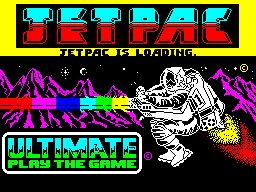 Some images you can hear
If you owned a ZX Spectrum in the 80s then you undoubtedly knew the name "Ultimate: Play The Game" and associated it with titles that were a cut above their peers. It's less well known that founders Tim and Chris Stamper worked on arcade machines before forming Ultimate (actually just the trading name of the less snappy-sounding "Ashby Computers and Graphics"), but it should come as no great surprise to anyone who has taken even a cursory glance at their debut title JetPac. The multicoloured laser that your character fires is a direct lift from Defender. That the gameplay takes place on a single screen dotted with floating platforms invokes another Williams' hit, Joust. And while I think claims of "it wouldn't look out of place in an arcade" are overselling it somewhat, it's as instantly accessible as the best of them. You could mosey up to it at any time and quickly grasp the gameplay loop: fly around the screen, avoid or shoot the baddies, pick up the rocket parts and fuel until the spaceship starts flashing, then jump in to blast off to the next level. Easy.
JetPac wasn't the first video game I ever played - that honor belongs to a generic Pong console, probably made by Binatone or Grandstand - but it might well be the first I played on a ZX Spectrum. When my dad brought that machine into the house I quickly became obsessed, and it set me down a path of computer geekery that shaped the rest of my life. But I don't think it's just nostalgia that keeps me coming back to JetPac. There are lots of games from that period that I remember fondly but which don't hold up when revisited. But when I set up a Spectrum emulator on a new device - most recently the Anbernic 405m I purchased a few months ago - it's usually the first game I try, more than 40 years after its release in May 1983.
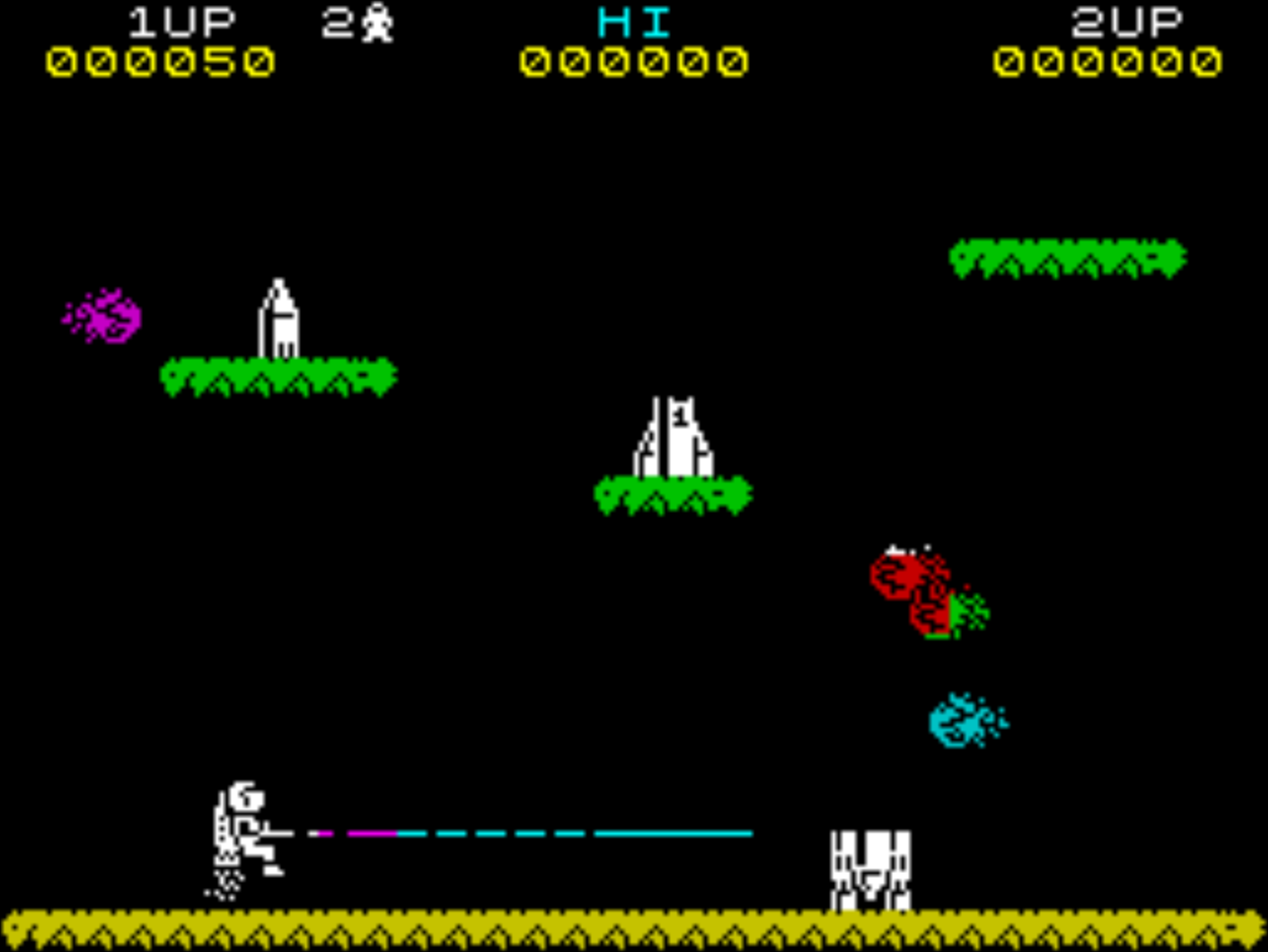 Pew pew, etc...
It's a simple game, and you can probably come up with a dozen things you'd add to it off the top of your head right now. Changing the platform layout across different levels is maybe the most obvious, given that the planets that Jetman visits differ only in the type of enemies that reside there. Maybe you'd throw in some power-ups or a two-player competitive mode. But when you realize that this is one of the few games compatible with the short-lived, lower-cost 16k Spectrum, it's impressive that they managed to squeeze so many enemy types and spaceships to build into a memory footprint smaller than most web pages. A tight scope was an inevitability when cramming a game into just 16k, and while there aren't many moving parts to JetPac, they mesh perfectly. The fuel tanks keep the player moving around the screen, the aliens provide danger, the platforms a degree of solace, the bonus items encourage risk-taking in return for higher scores, and the different spaceships grant a sense of progression to the skillful.
Ultimate were always good at working around the Speccy's limitations and playing to its strengths. Colour-clash (a symptom of its inability to display more than two colours within one 8x8 pixel square) is kept to a minimum by careful arrangement of the scenery. And while the original Spectrum wasn't known for its sonic capabilities I do actually like the sound effects, such as they are. Enemies explode not with a boom but with a kind of wet squelch which works with the puffy little cloud that they disappear into. Rose-tinted headphones on my part, perhaps, but effective.
JetPac's simplicity is its strength and why it's a game I keep returning to almost exactly 40 years later. Maybe the controls and many of the enemy patterns - the little fighter jets that hang out at the edge of the screen then dive bomb you are my favourites - are burned into my memory from having played it as a spongy-brained youth. But I can put it down for months... years... and playing it again is immediately enjoyable, like a visit from a childhood friend, without feeling like I have to relearn anything.
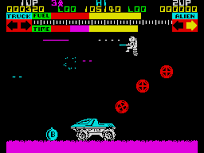 Lunar Jetman. Not as good.
A sequel, Lunar Jetman, followed later in 1983. Targeted at 48k Spectrums, it featured a scrolling landscape, a drivable "lunar rover", teleporters, and enemy missile bases that Jetman had to locate and destroy... and wasn't nearly as much fun.
The Stampers sold the Ultimate name in 1985, founded Rare, and abandoned the Spectrum for the more lucrative world of home consoles. I haven't spent enough time with 1990's NES-exclusive Solar Jetman to form an opinion on it, though it has more in common with games like Thrust or Oids than its predecessors.
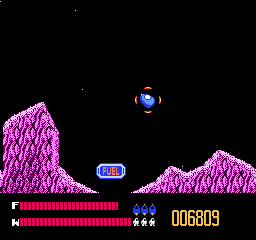 Solar Jetman. On the NES, so obviously not as good.
JetPac may not have spawned a franchise to rival the Marios and Sonics of this world, but it has remained oddly tenacious, thanks to both its fanbase and the Stampers, who throughout the successes of the following decades never forgot their humble origins on that tiny 8-bit computer with the mushy rubber keyboard.
The titular Jetman got his own comic strip in Crash magazine for a while (recently reprinted by Fusion Retro Books.). Donkey Kong 64 (1999) had a Spectrum emulator and a copy of the game hidden in it. Various homebrewed remakes and homages have surfaced over the years, such as Super Jetpak (sic) DX for the GameBoy Color and Jetpac RX which adds to the original Spectrum version.

Finally, 2007 saw the release of Jetpac Refuelled. This Rare-developed reimagining didn't set the world alight, but was good fun, got respectable review scores, and it was rather lovely to see that old Ultimate logo pop up on a game for a modern system. It's just a shame it's still an XBox-exclusive after all these years. Backwards compatibility means that it's still playing on your XBox Series-whatevers even though the 360's online store is closing down, but it would still be nice to see a PC version one of these days. With Microsoft still in possession of Rare and all its IP though, I won't hold my breath.
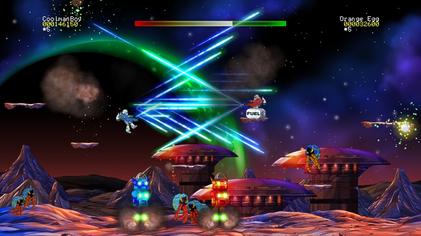
If you want to play the original JetPac however, and you can't be arsed faffing about with a Spectrum emulator and finding a tape image, you can do so in your browser RIGHT NOW thanks to the Internet Archive!
Clickshot 2 Turbo
"Oh dear. A critical software bug has caused the autopilot of your Maxikill 9000 advanced space-fighter to go do-lally, and the only control still working is the weapon fire button. Death is certain, but how many mutant alien scum can you take with you?"
About five years ago I was looking for a jam to take part in that would motivate me to knock out a quick little game and give me the sense of having actually completed something. I came across 1-Bit Clicker Jam, the rules for which stated that the games should have 1-bit (ie, two colour, normally black and white) colour and be controlled only with the mouse. I think the intention was that it should also be an idle game along the lines of Cookie Clicker but I didn't quite get that at the time and had (and still have) a hard time grasping what actually defines a clicker game. I guess one where there is a very thin layer of strategy on top of a game loop that just involves clicking the mouse over and over to progress?
Anyway, I had an idea for a game that met the technical restrictions if not the spirit of the jam, but which was, in retrospect, VASTLY overspecced for the limited amount of time that I had. I set to work on it, and while it was coming along fairly well, as the end of the two-week period drew closer it was obvious that I was nowhere near being able get it into a submittable state.
(I did, eventually, finish that game, but I'll write about that one later.)
So on the night of the deadline I sat down, cracked open Unity, and threw together Quickshot 2 Turbo in a couple of hours.
 Pulse-pounding action!
It's basically a top-down shmup where the only control over your ship is to fire by clicking the mouse button. Your vessel is out of control and lurching from one side of the screen to the other, so it's all about timing your shots just right to hit the enemies before they smash into you. To discourage the player from just hammering the fire button, an energy bar at the top of the screen depletes every time you shoot and takes a little while to recharge, so mindlessly spamming shots can result in you running out of energy and being unable to fire when you need it the most. There's a score multiplier that you can build up by killing enemies in quick succession, and powerups drop down the screen every so often. Shooting them grants your little vessel a series of upgrades, like double-shots, side-shots and so forth. There are only a handful of enemy waves that repeat infinitely, but they gain more health over time until it's just not practical to actually kill them and you are inevitably overwhelmed. It does suffer somewhat from the "Gradius Effect", where you can be doing quite well on a tricky level then lose a life, which causes you to lose all your powerups and inevitably lose the rest of your lives quite quickly because you've gone from a fire-spitting angel of destruction to a wimpy pea-shooter.
Ok, it still doesn't meet the spirit of the jam, but it does have 1-bit graphics and is controlled entirely by mouse clicks. And while it's not much good, I think it's not bad for the amount of time I spent on it. Oh, and you can play it in your browser right now, if you like.
And the name? It's not like there was a Clickshot 1 for it to be a sequel to. Well, retrogamers of a certain pedigree will recognize it as a homage to one of the greatest controllers there ever was: the Quickshot 2 Turbo.
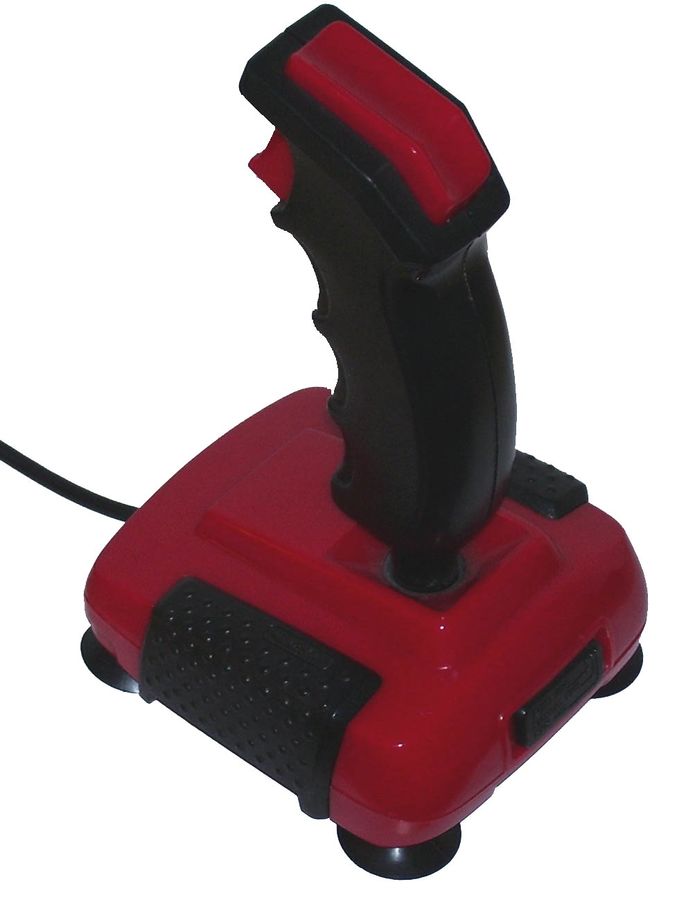 Look at those sexy studs!
(If you like the basic idea of this game, it's not a million miles away from the far far better Switch 'n' Shoot)
Games I Love: Akka Arrh
(2023, Llamasoft / Atari Played on PC and Nintendo Switch)
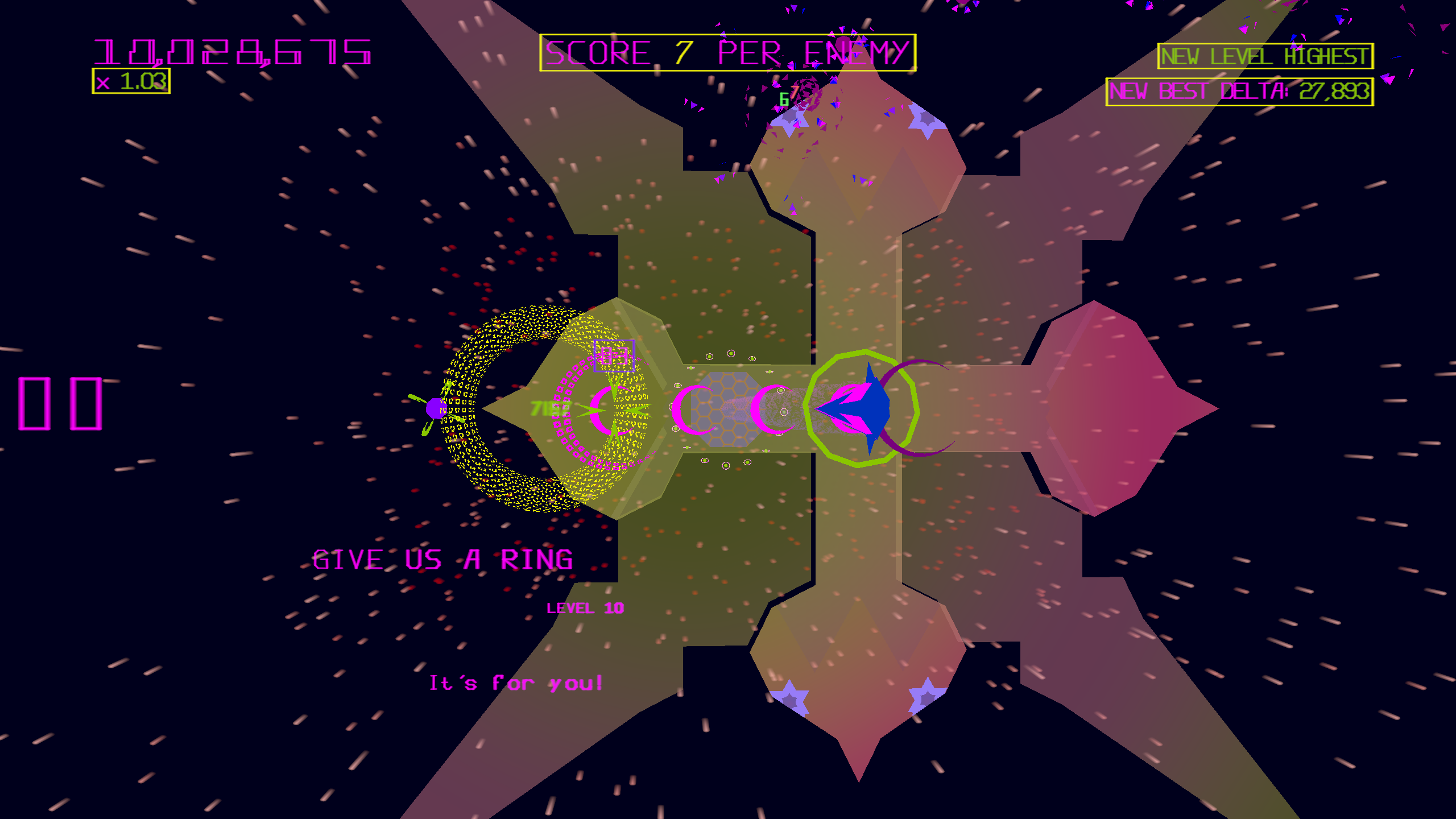 An in-game screenshot of Akka Arrh
I can admit it: I'm a bit of a Llamasoft fanboy. They're one of the handful of developers whose games I will buy on release day sight unseen. I was dimly aware of Jeff Minter during the 8-bit days, as this weird hippy-looking guy who made wacky games for the Commodore 64 that involved sheep and goats and other ungulates, but ours was a Speccy household and it wasn't until I upgraded to an Atari ST that I encountered the amazing Llamatron and became a full-blown fan.
It hasn't always been easy, though. I never owned an Atari Jaguar and had to wait for emulation to become a thing before I could sample the much-lauded Tempest 2000. I still have never played its sequel, Tempest 3000, but very few have given that it only appeared on the short-lived Nuon platform. There was a string of games for the Palmpilot (though fortunately those did eventually get Windows releases) and then a bunch of iOS-only things that as an Android user I was locked out of. But it seems churlish to complain. How many others of the 8-bit bedroom-coding era are still making games four decades later, without burning-out, being absorbed into a huge studio, or just leaving the industry altogether? And even during those fallow years, keeping up with Llamasoft wasn't a chore. From his monthly column in ST Action magazine, through the years of personal blogs and message-boards, and into the modern social-media era, Minter has presented a gently approachable figure, regularly sharing updates on his games as well as life in Wales with his partner Giles and flock of spoiled and happy sheep.
Fortunately Llamasoft (having doubled its number of devs since the 2000s to a staggering two with the addition of Giles) has in recent years returned to the more egalitarian shores of PC-based gaming, with some of their games also getting multi-platform releases on modern consoles such as the Switch.
Now, I describe myself as a fanboy, but I can't honestly say I love all their games. (With something close to seventy published titles over the years, how could I?) The recent Moose Life was one that I didn't entirely click with, for example, but they're always interesting, visually and sonically intense and immediately recognizable. I can honestly say that I've never regretted spending money on a Llamasoft game.
Llamasoft's relationship with the-entity-that-calls-itself-Atari seems to have undergone almost as many ups-and-downs as that beleaguered trademark itself. Tempest 2000 was one of the only reasons to own a Jaguar. Minter's second game for the platform attempted to do for Defender what T2K had done for Dave Theurer's Tempest, but Defender 2000 was allegedly hamstrung by rushed deadlines and corporate interference and didn't make the same mark, and Minter soon left Atari along with several other employees to form Nuon Labs and create the aforementioned Tempest 3000. 2007's much-misunderstood Space Giraffe added its own spin (pun intended) on Tempest-like tube-shooter gameplay, but TxK for the PS Vita was considered too close to the bone, and Atari's lawyers brought the copyright hammer down on the one person who had kept the Tempest name alive all those years, getting it pulled from sale. Luckily for us non-Vita owners, someone at Atari knew a good game when they saw one, came to an agreement with Llamasoft, and the game resurfaced shortly afterwards, suitably tweaked and renamed Tempest 4000. Luckier still, if there's any animosity remaining between Llamasoft and whatever-Atari-is-this-week it didn't stop them from contracting Jeff and Giles to produce a remake of hyper-obscure canceled arcade game Akka Arrh, resulting in quite possibly my favourite game of Llamasoft's storied history.
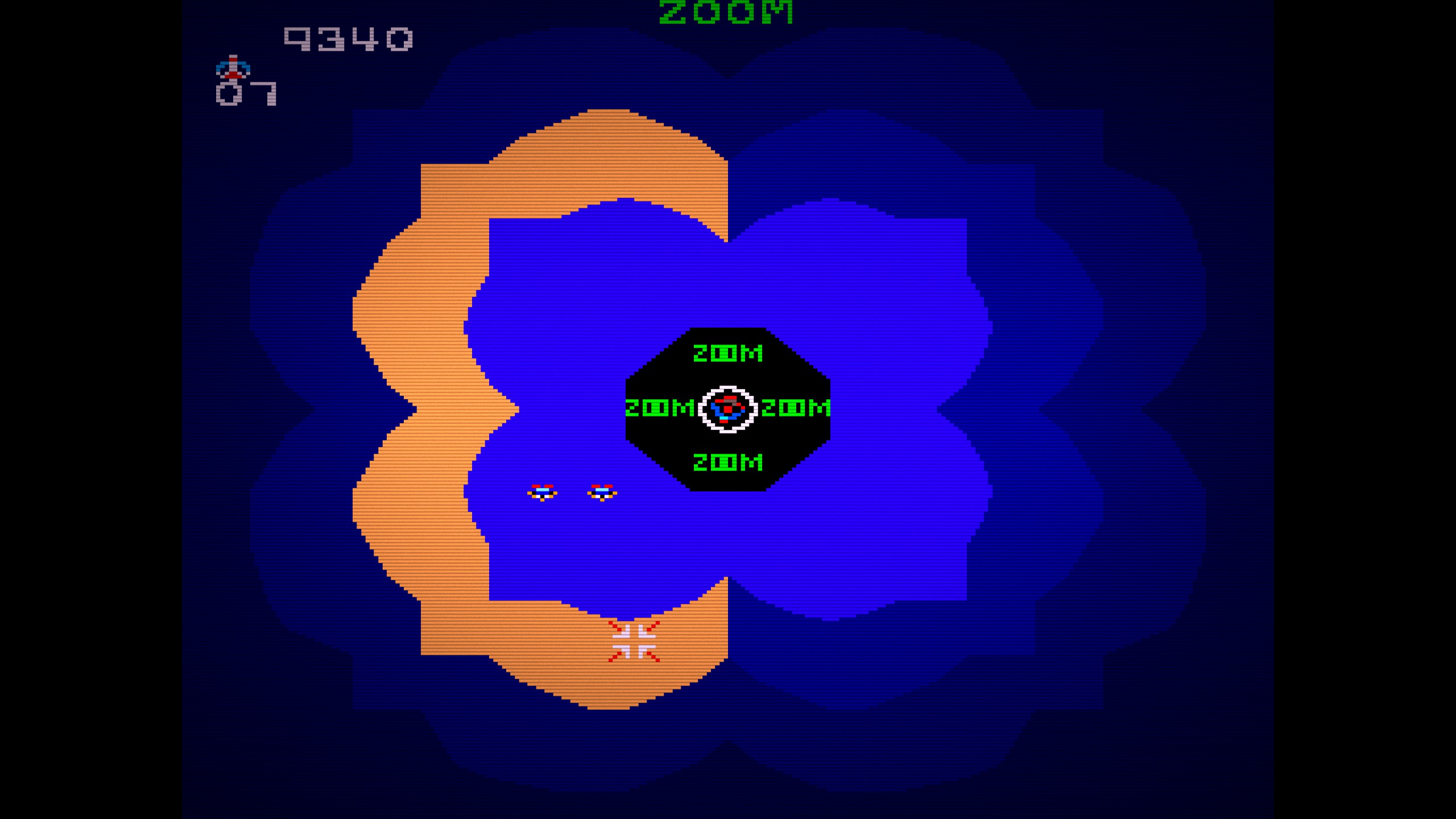 Screenshot from the original arcade game. Taken from Atari 50.
Akka Arrh began life in 1982 as a coin-op that only made it to the prototype stage, and never saw a full manufacturing run after it failed to connect with arcade-goers in test locations.The ROMs were only dumped a few years ago, though if you want a nice, convenient and legal way of trying it out, it appeared last year's excellent Atari 50 compilation. (In fact, part of me wonders if the Llamasoft remake wasn't originally intended to be a part of that collection, given that it includes reimaginings of a couple of other early Atari games, but it turned out to be too good to be buried like that and got a solo release instead. Sidenote: Atari 50 is also one of the best ways to play Tempest 2000.)
In its original incarnation Akka Arrh puts the player in control of a turret in the center of the screen, which can rotate to face a free-moving cursor controlled by a trackball, but which cannot move. Surrounding the turret are a number of colourful geometric planes. Abstract swarms of enemies enter the level and attack the turret, but instead of shooting them directly, the player can fire one "bomb" at a time that annihilates all enemies that are above the plane that it hits. The strategy comes from watching for windows of opportunity when multiple enemies are above the same plane and firing a bomb to take them out all at once.
If enemies get too close to the turret the player is prompted to "Zoom In" by hitting a button on the cabinet. This switches to a "close-up" view of the turret as enemies attempt to breach its shields and destroy it. The shooting in these stages is more conventional with no surfaces or bombs to worry about, just streams of bullets fired towards the cursor, though they always stop when they reach it, so placing it slightly "beyond" the enemy you're aiming at can be helpful.
The coin-op isn't bad. It certainly doesn't look like anything else in the arcade at the time, with its large, symmetrical geometric patterns. It's easy to imagine an early-80s arcade-goer being drawn in by its looks then walking away confused having deposited their quarter expecting a simple shooter and finding something much less intuitive. On the other hand, with a bit of difficulty tuning it could have found its audience and become a cult favourite, but cult favourites don't make the big bucks.
Llamasoft's remake benefits from not having to extract coins from the pockets of 1980s teens and layers additional mechanics to make a far more interesting game. The basic structure is the same - the turret in the middle, the geometric planes, the "zoom-in" mode. But bombs no longer automatically destroy all enemies that happen to be above the given plane, but instead cause an expanding "explosion" that has a different shape, lifespan, speed and symmetry on every level. Enemies destroyed by these explosions trigger their own, allowing a single well-placed shot to trigger long explosion chains that supercharge your score multiplier, but every time you fire a bomb that multiplier is reset to zero. Regular bullets can also be fired and don't reset your multiplier but are in short supply, only replenished by destroying enemies with explosions, and count towards your end-of-level bonus. Calling Akka Arrh a shooter seems like a misnomer when it's a game that actively rewards you for not shooting if possible, and like the best score-attack games, getting large numbers of points isn't just about showing off your prowess with a prominent position on the high-score table. It's vital to renewing your lives (or "pods" in this game) and keeping your game going for longer.
Some enemies trigger their own explosions when shot and are worth picking off with bullets first rather than waste a multiplier-resetting bomb. Others cause sections of the planes to disappear temporarily, making your job a lot harder, and are worth just ignoring and letting them float past, assuming they aren't on a collision course with your turret. Some fire shots of their own that fly off the screen first, before turning around and heading towards you at speed - a mechanic that I found extra frustrating at first until I noticed the little "tinkle" noise that accompanied their reversal and learned to anticipate their return. (There are probably accessibility concerns there that I am not qualified to weigh in on, but I wouldn't want to play this one with the sound off.)
Even when things get hectic, there's very little call for mindless blasting. Akka Arrh's levels are more like puzzles to be solved than tests of reflexes, and if they get out of hand it's probably because you haven't cracked the formula to keeping the current one under control. Do you use bombs or bullets? Do you deal with an enemy wave now or wait until they are over a more advantageous section of the level? Blast the shots that are heading away from you or use those precious seconds elsewhere and deal with them when they return? If a game is a series of interesting choices then few in the broad genre of "shooters" offer as many.
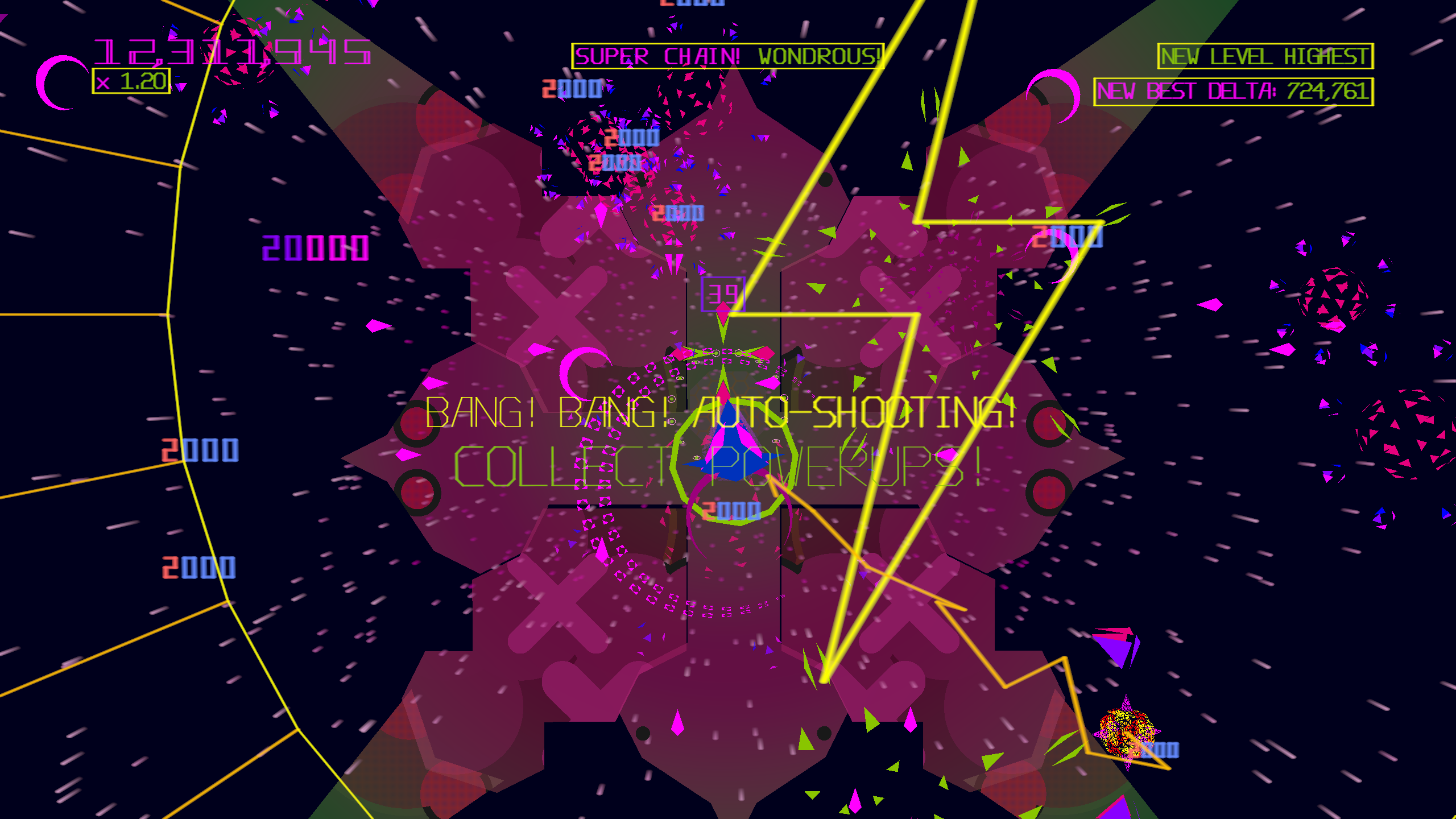 Things get characteristically trippy
Of course, this reimagining is full of Minterian touches that make it immediately recognizable as a Llamasoft game. Enemies explode into clouds of colour-cycling particles. Wibbly strings of text float by, humorously mocking (or praising) your performance, or just making fun references to hooved beasties. While not as retina-scorching as other games in their catalogue, collectable smart bombs will still cause the screen to warp and shatter. Sound effects consist of samples seemingly accumulated at random from classic coin-ops, household objects, assorted voices and (once again), those beloved ungulates. The banging techno soundtrack that accompanies most of their games is missing, replaced instead by ambient tones and washes that are triggered by your actions, enhancing the genuinely contemplative and relaxing moments that occur when you have mastery over a level and are clearing it with ease and minimal use of your arsenal. (Minter's love of old-school rave aesthetics is still apparent when you have to zoom in, though. Called "going downstairs" in this version, its sound effects include 808 hand-claps, piano stabs and airhorns.) This is a game that understands that a difficulty curve needn't be a consistent climb to the top, but that keeping the player engaged requires throttling back sometimes and letting them use what they've learned so far to feel a sense of accomplishment that offsets the frustration.
It's difficult to do justice to Akka Arrh's mechanics in text without them sounding over complicated, but it gets the delicate balance of rewarding the player for their newly acquired skills then further complicating itself in order to demand more of them so perfect that it's an absolute joy to play.
Feed me!
My little blog generator now spits out rss and atom feeds. Yay.
Now to try and figure out some minimal analytics without using Javascript. I have a bloody-minded determination to restrict this site to just html and css.
Making Markdown
My tiny little #site generator now supports writing posts in markdown! That's nice isn't it?
I've also thrown the code up on Bitbucket in case anyone else finds it useful, but like I said, it is extremely simple, has precisely zero test cases, and is the product of just a couple of hours work. I'll add to it though, it's kinda fun.
Hello there
So with the flaws of centralized social media making themselves crystal clear, owning ones own content and means of publication is becoming appealing once again, just like it was in the old days of blogs, where everyone had their own website and linked to each other, rather than everytyhing being siloed in just three or four megasites.
Another positive about the "old" web, was that web pages were relatively lightweight things made of html, css, maybe a handful of images. If Javascript was involved it was kept to a minimum, updating a visitor counter or enabling a comment section. Nowadays even sites that seem relatively simple to the naked eye might be downloading megabytes of framework dependencies that even the developers can't keep track of.
To that end I thought I'd have a go at setting up some kind of blog here, on space that I personally own and pay for, and try to keep it as simple as possible. I hacked together a simple static site generator in C# in a couple of hours. It takes plain text files and does some very basic string replacement to inject them into html files and gets them ready to upload. If my host goes down or I forget to pay the bill or they turn out to be nazis or something, the whole site still lives on my local machine and can be moved wherever.
I should probably add RSS feed generation, and I'm thinking of having it pull in posts from other feeds such as my itch.io page, Mastodon account, and maybe my old Twitter archive that I downloaded before nuking my account, but we'll see.
