

42. Fate of the World
- Date Added: November 10 2011
- Last Played: November 16 2011
- Play Time: 14 minutes
- Store Page
This is the worst kind of strategy game. The type that floods you with stats and asks you to make decisions with no clear indication of how the two are related. In Fate of the World you are faced with a series of challenges to improve the planet and execute them by purchasing cards that are applied to certain countries per turn. Each card is something like "invest in nuclear power" or "implement educational programs", and more funds are earned by improving overall quality of life.
I lost the first mission by not raising Africa's "Human Development Index" to 0.7 apparently but I'm fucked if I know how I should have done that. I'm sure there's a certain kind of brain that enjoys this kind of thing but it ain't mine.
Would I play it again? Zzzzzzzzz ...
41. Nightsky
- Date Added: November 10 2011
- Last Played: November 16 2011
- Play Time: 11 minutes
- Store Page

Man, the early 2010s were a great time if you're a fan of 2d puzzle platformers with a gimmick. Nightsky is a 2d puzzle-platformer and the gimmick is that you are a spinning ball which has a "special power" that can change from one level to the next. It's presented largely in silhouette, not unlike upcoming 2d puzzle-platformer Limbo, but unlike that game's horrible nightmare world, Nightsky's backgrounds are all pleasant gradient sunsets. (Or are they sunrises?)
It's all quite nice and chill, though the game's need to spell out in plain text what the action button does on each level (Does it give you a speed boost? Does it invert gravity? Does it do bugger all?) feels a little bit ham-fisted and nowadays I would expect some more implicit tutorializing.
Would I play it again? Yeah, I could see myself taking ten minutes to knock out a level or two on the sofa.
40. The Binding of Isaac
- Date Added: November 1 2011
- Last Played: June 26 2012
- Play Time: 38 minutes
- Store Page
The first roguelike of the collection so far, though we'll start to see many many more before too long, and another where the Steam play time is misleading. I've played various version of The Binding of Isaac far more than this, the slightly-janky Flash original. Specifically the 3DS and Nintendo Switch releases.
I don't really love it though. I like it well enough. I enjoy roguelikes, I enjoy games that let you build strange and unlikely synergies of powerups and weapons, I enjoy arena-shooters. But I'm not thirteen years old and Edmund McMillen's "peepee-and-poopoo are funny and also religion is bad and I'm dark and edgy" thing doesn't really land with me.
Would I play it again? This Flash version with keyboard-only controls and 30fps cap? Nah. In fact I don't even know why it's still for sale as its own thing in parallel with the remaster. Why not just bundle it in with Rebirth so that the curious can see where it came from and people don't buy it by accident then wonder why this oft-praised game is so thin?
39. Gish
- Date Added: November 10 2011
- Last Played: November 11 2011
- Play Time: 6 minutes
- Store Page
Before Meat Boy and Isaac et al, Edmund McMillen first gained some attention with puzzle-platformer Gish. It's mostly pretty standard get-to-the-exit without dying stuff, not a million miles away from yesterday's game Blocks That Matter. The gimmick here being that your character is an amorphous blob of tar with a cartoon face, who can squeeze through gaps, stick to walls, etc.
It's a technically clever trick but I can't say I found it particularly enjoyable to play. Perhaps as an inevitable outcome of controlling a squishy semi-solid blob, the controls feel imprecise and fiddly. On top of which the level design is pretty uninspired and often results in deaths that feel unfair, or in some cases your blobby hero just getting outright stuck. The way the stages just seem to end when you reach a certain point without any obvious exit or finish line makes the whole thing seem unpolished. Because it's almost the exact opposite of Super Meat Boy - a game feted for its super-tight controls and level design - it's tempting to imagine the latter being a direct response to this game's failings.
Would I play it again? No, I would not.
38. Blocks That Matter
- Date Added: November 1 2011
- Last Played: April 25 2012
- Play Time: 19 minutes
- Store Page
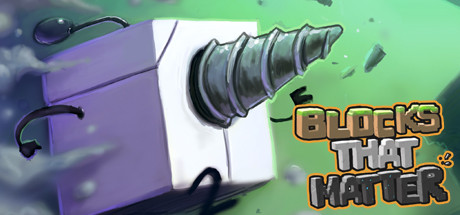
Blocks that Matter is a sweet little puzzler where your cuboid robot can drill and absorb certain types of blocks and put them down in order to build the platforms needed to reach the exit of each level. The twist is that they can only be placed in groups of four in order to make Tetris-style tetrominos. And not-coincidentally, lining up enough of them in a row can cause the whole lot to disappear - handy when you can only drill left, right and up.
It's often trickier than it sounds, requiring some careful consideration to build a path without boxing yourself in. Naturally there are further complications as you get into the game, as well as secret collectables that pay homage to other games that influenced it.
Aesthetically you might think it looks like a simple Flash game from screenshots, but it's the animation of the little bot somehow renders it utterly adorable despite being essentially a washing-machine with stick-figure limbs.
Would I play it again? For sure. At least until I get stuck.
37. Ghostbusters: The Video Game
- Date Added: November 1 2011
- Last Played: November 7 2011
- Play Time: 57 minutes
- Delisted from store
When I were a small lad, growing up in 1980s Britain, the United States of America seemed like a distant science-fiction land that was bigger, shinier and more advanced than the dull, sodden island on which I lived. It was like a country that had been shifted slightly into the future but from which we would still get occasional communiques. Obviously this was a lie sold by Spielberg films and glitzy soap operas, and regular Americans suffered from poverty, misery and degradation as much as anyone else, but the filter of family-friendly entertainment media made it seem like a wonderland. This was compounded by the fact that most American media took months or sometimes years to make it to our shores. I remember all sorts of playground chatter about Return of the Jedi, for example, long before we were able to see it in British cinemas, including one young bullshitter who claimed to have seen it on holiday but refused to give up any details.
One conduit to the future was a show called Entertainment USA, in which record producer and future jailbird-nonce Jonathan King would preview the television, movies and music that were topping the charts in the States and that we would get to see one day if we were lucky. And so it was that I got my first fleeting glimpse of Ghostbusters.
Such was the spark that lit the blue touch paper of Ghostbusters-mania in the UK, and by the time it hit British cinemas, some six months after its US premier, the previews, hype and chartbusting theme song had nine-year-old me in a tizzy and I begged my dad to take me to see it. I still remember the audience singing along with the theme, which seemed shocking to a little kid who had been trained to never ever talk during a movie.
Of course I loved it. How could I not? I didn't know who Dan Aykroyd, Bill Murray or Harold Ramis were but I could tell that they were funny chaps. There were some exhilarating-but-not-nightmare-inducing scares, sci-fi elements, amazing special effects, naughty swears and Sigourney Weaver making me feel strange in a way that I didn't entirely understand yet.
I was immediately a fan and was delighted to receive the Ghostbusters video game for the ZX Spectrum that Christmas. In retrospect not a great game, and it looks especially poor when compared to the Commodore 64 version, but I loved it. You drove around town, catching ghosts with proton-packs and traps in order to hold off the inevitable arrival of Gozer and the giant Stay-Puft Marshmallow Man, under whose stomping feet you had to guide your team in order to get to the dimensional portal at the top of Dana Barret's apartment building and shut it down by crossing the streams. It even had a beepy version of the theme tune at the beginning and a crackly sampled voice that yelled "Ghostbusters!" as soon as the tape finished loading. I couldn't have asked for more.
Naturally, over time, my Ghostbusters fever cooled. I watched The Real Ghostbusters cartoon show, and it was ok, but I couldn't get over how the gang very obviously weren't voiced by the original actors. Why did Peter Venkman now sound like Garfield? And why was it called The Real Ghostbusters? Wasn't the movie real enough? (The answer to this is worth a whole other blog post and I've digressed enough already.) The 1989 sequel wasn't that great, though I'd still watch the original from time to time. As an adult its politics started to grate on me a bit, with it's Reagan-era moral seemingly being that plucky young entrepreneurs should be allowed to do whatever they damn well please and anyone who tries to stop them is a pencil-dicked bureaucrat who hates free-market capitalism. Putting that out of mind, it's still a good time 40 (Fuck!!) years later.
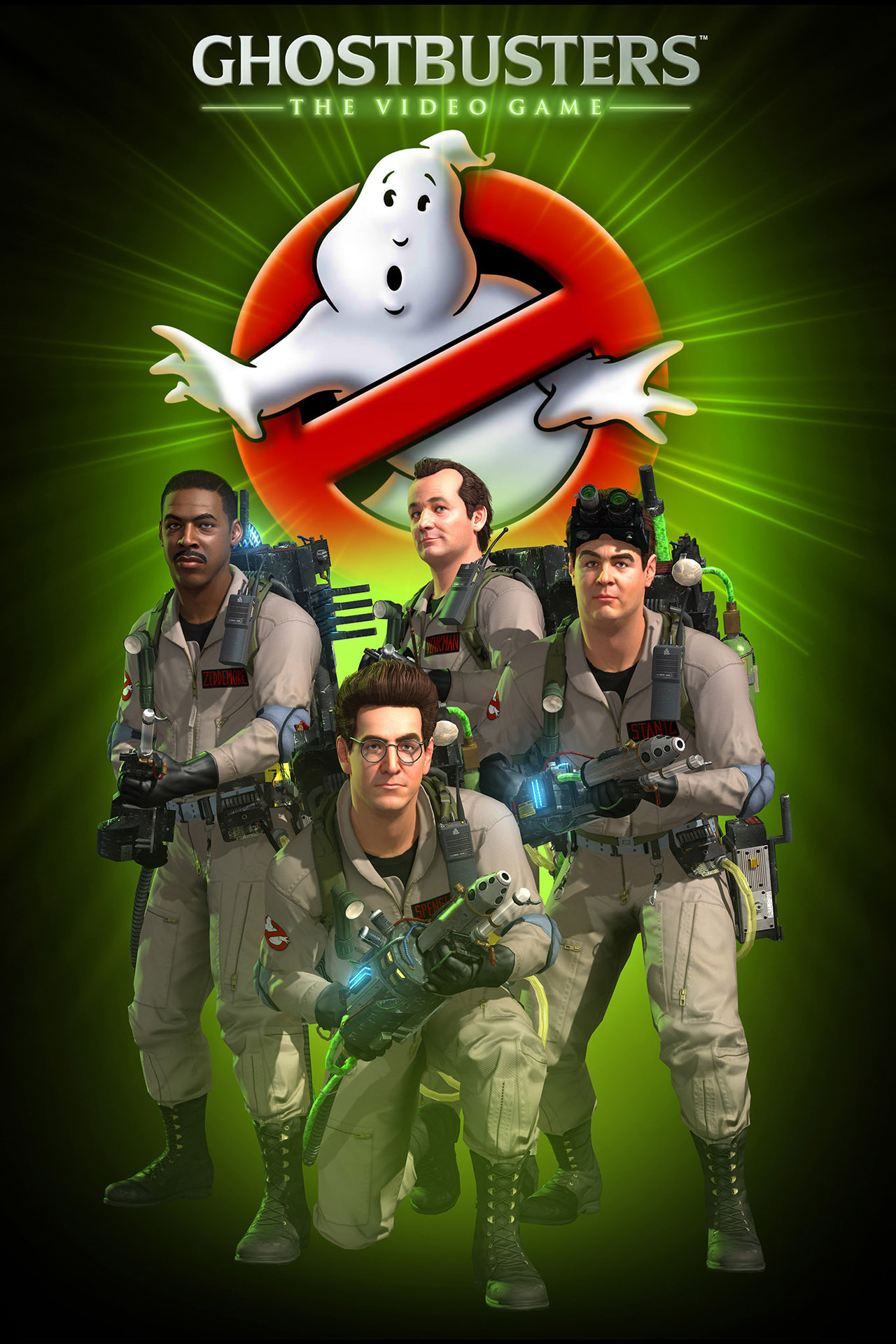
Rumours abounded for years about a potential Ghostbusters 3, with Murray allegedly holding out for the perfect script, but in the late 2000s someone must have said the right things or waved a big enough check in front of him, because he and many of the original cast reprized their roles in an official sequel, not as a movie, but in the form of Ghostbusters: The Video Game. Co-written by Aykroyd and Ramis and described by the former as "essentially the third film", the player takes on the role of an anonymous new-hire, brought on by the team a couple of years after the events of the Ghostbusters II. Played mostly in third person, you get to indulge in some classic Ghostbusting action, exploring haunted locations, zapping ghosts with your proton pack and dragging them into traps, while advancing an all-new story involving Gozerian cultists trying to open a portal to the spirit world.
In the little bit of time I spent with Ghostbusters: The Video Game it sure lit-up my nostalgia-circuits, with lots of locations from the movie now being fully modeled 3D spaces to explore, down to the arcade-machines in the corner of the firehouse. (Sadly not playable.) If you showed this to ten-year-old me my mind would be completely and utterly blown. Rose-tinted glasses aside I still had fun with the first few sections, with all the tools of the ghostbusting-trade being a joy to use. It turns out that even after all these years, bustin' still makes me feel good.
(I'm so sorry.)
Would I play it again? I enjoyed my time with it and wouldn't mind playing more, but I have the remaster in my library also, so I'll likely give that one a go instead.
36. A.R.E.S.: Extinction Agenda
- Date Added: October 30 2011
- Last Played: November 1 2011
- Play Time: 11 minutes
- Store Page
If the generally-agreed upon features that make up a Metroidvania-style game are 2d platforming in a non-linear, explorable environment where the player can find powerups that allow them to access new sections of the map, then they were all present in the original Metroid back in 1986. But it wasn't until 1997's Castlevania:Symphony of the Night that the other half of the portmanteau caught up. Depending on how you count them (no pun intended), it took something like 13 games for the Castlevania series to produce a true Metroidvania game. Before then most of the series were linear action-platformers with a lot of left-to-right travel, dispatching monsters on the way to fight a big end-of-level boss. (Pedants will at this point bring up the nonlinear parts of Simon's Quest and Vampire Killer and I will ignore them.)
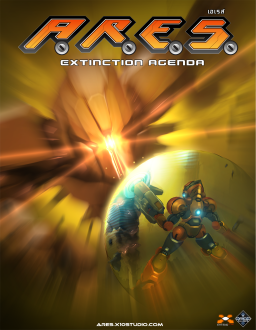
All this is to say that if the roles were reversed, then A.R.E.S.: Extinction Agenda would be the linear Metroid that never was. The player traverses levels that take them through grungy space-stations, blasting hoardes of enemies until they fight a big robot boss at the end. There are hidden areas, some of which can't be accessed until you replay a level later on, and enemies drop resources that can be crafted into grenades or weapon upgrades, not unlike how oftentimes one will have to hang around and shoot a bunch of aliens in a Metroid game until they drop enough rockets to proceed.
I quite liked the twin-stick control scheme that let my little guy move and shoot in any direction, and there's some nice sprite work which served as a good reminder that 2d game art doesn't always have to be chunky, retro and pixellated. But it felt repetitive quite quickly and didn't really grab me enough to keep playing once my first game was up.
Would I play it again? Given that I have to sit down at my desktop PC and reboot the poor thing into Windows, it would have to be an absolute banger, which it's not. I believe there's a remaster that might behave better, but I don't have it in my library.
35. Shadowgrounds: Survivor
- Date Added: September 30 2011
- Last Played: Never
- Store Page
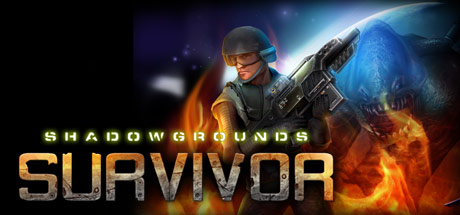
More aliens to shoot, more keycards to find, more scifi metal corridors to wander around. Shadowgrounds: Survivor adds some new weapons and upgrades, dumps the cheesy cutscenes, and is very proud of its new physics engine that lets you bounce crates around, but is ultimately just a slightly more polished Shadowgrounds. Which is a good thing, if more Shadowgrounds was what you want. I don't, but you do you.
Would I play it again? The first one was fine but uninspired, and Survivor doesn't seem to bring much new to the table, so again, probably not.
34. Shadowgrounds
- Date Added: September 30 2011
- Last Played: October 30 2011
- Play Time: 31 minutes
- Store Page
Taking a step back to tackle a couple of non-Steam-Deck compatible games that I skipped, now that I've had time to boot into Windows and give them a try.
With its infested moonbase, endless gray sci-fi corridors, and monster closets that wait for you to get close then spit out baddies, at first glance you'd be forgiven for mistaking Shadowgrounds for a third-person camera mod for Doom 3. Once you actually play it you'll realize - that's pretty much what it amounts to... top-down Doom 3.
Get through the levels, look for ammo and keycards, and shoot a bunch of monsters. There's a weapon upgrade system and some friendly NPCs that can join you. but beyond that there isn't much that's innovative about Shadowgrounds, and several things - like the godawful cutscene acting and simplistic character models - that have aged quite badly since its 2006 release.
Would I play it again? I doubt it.
33. Nimbus
- Date Added: October 30 2011
- Last Played: Never
- Store Page
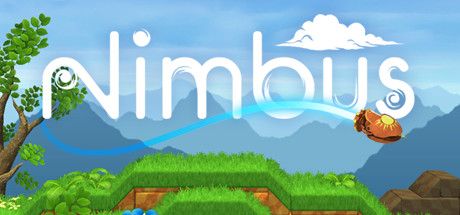
Nimbus is part platformer, part puzzle-game and part racer. You control a little unpowered glider that has to navigate various courses full of spikes, locked doors, etc. Controls are rotation-based, Asteroids-style, but to get up speed you either have to take advantage of gravity, diving down long shafts then pulling up, or by hitting the various cannons and boost-pads scattered around the levels.
It's all cute enough. The level art - at least in the first few that I played - owes an obvious debt to Sonic the Hedgehog's Green Hill Zone, and if it were released today I would snottily accuse them of using stock assets from Kenney for the UI, but I guess that's just what indie puzzle games looked like in the 2010s.
There are online leaderboards and time-trial races against your ghost, if you were the sort of person to get sucked into it and want to spend time shaving off tenths of seconds against yourself.
Would I play it again? If I bothered to try Nimbus when I first got it I might have spent more time on it, but I don't see myself coming back to it now.
